How does it work?
A slightly technical brief discussion
The Tesla coil has a preliminary stage that uses a conventional iron-core transformer to raise the line voltage of 120 Volts to 15,000 Volts.
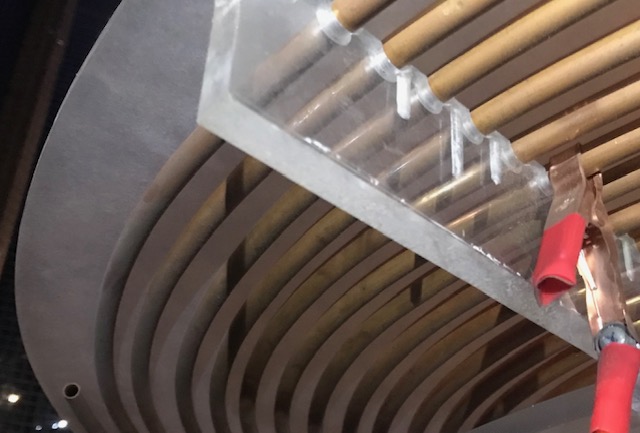
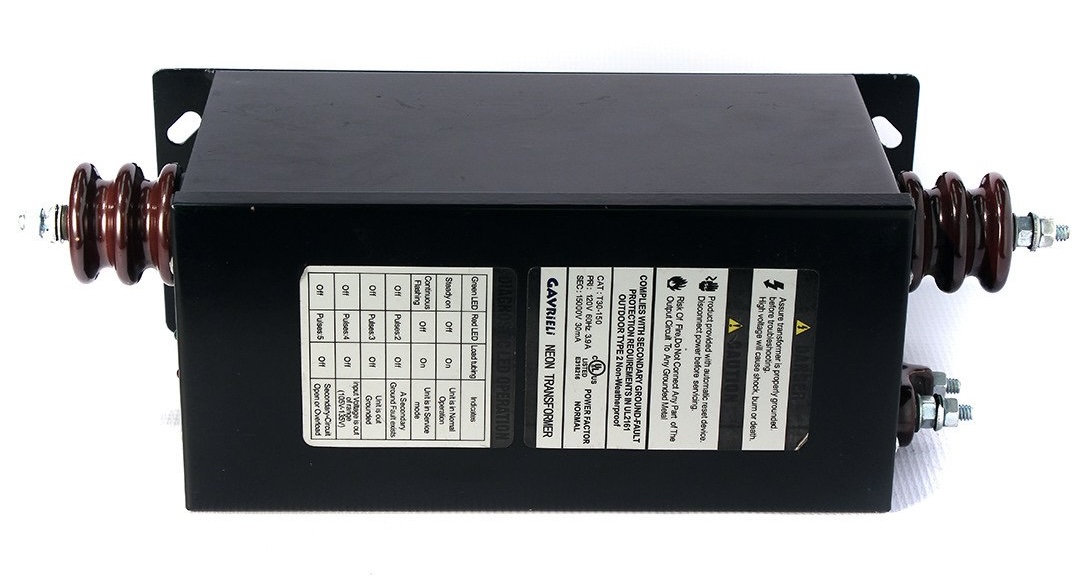 The output of this transformer is hooked up to a resonant circuit made up of the primary coil of the Tesla coil (located just below the white disk at the bottom of the tall secondary coil)
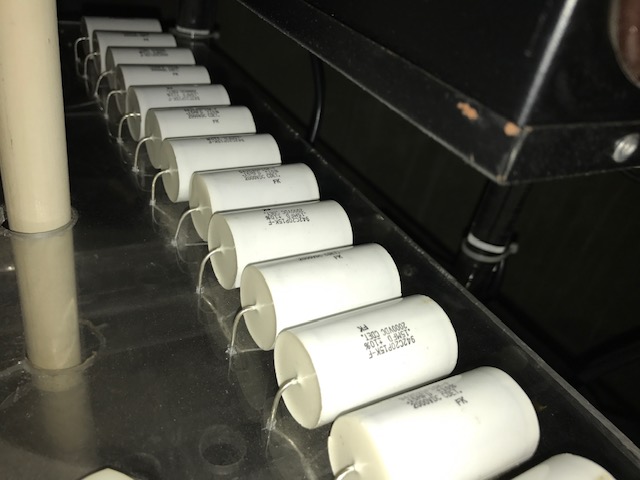
 and a capacitor which can store electric charge. The capacitor is the collection of white tubular components located in the base.
 15,000 volts is sufficient to cause the spark gap to fire, bridging the gap with a conducting plasma of electrons and ionized air molecules.
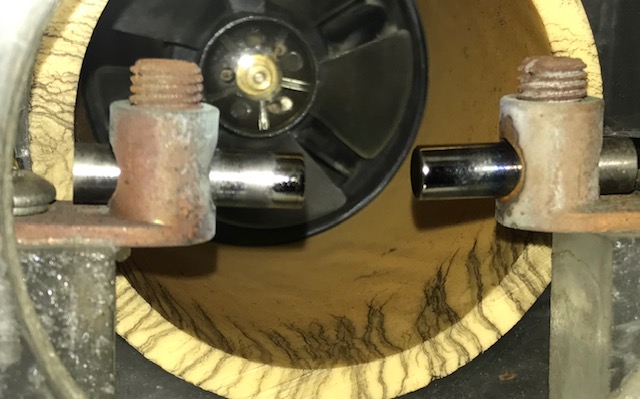 This completes the resonant circuit and starts it oscillating at its natural frequency of 90,000 Hz. Think of this as the electrical equivalent of plucking a guitar string. After firing, the gap continues to conduct during this oscillation phase. The electric arc across the gap is exceedingly bright, but is positioned so it is not directly visible. The oscillating current flowing in the primary coil is extremely high, which is why it is made of copper tubing rather than ordinary wire. This generates an oscillating magnetic field which couples it to the tall secondary coil.
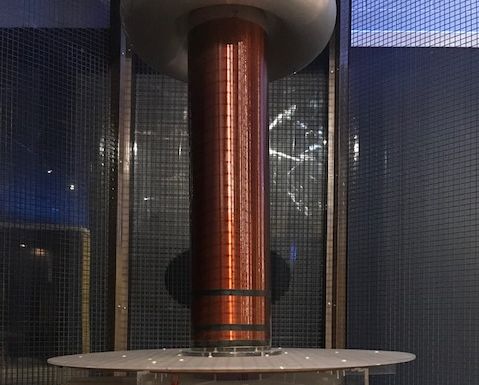 Because the secondary has many times the number of turns as the primary, it steps up the voltage. (The secondary has about 1000 turns of enamel coated copper wire.) The voltage is also enhanced by the fact that the secondary is also resonant at 90,000 Hz. The capacitance in the secondary circuit comes from the large donut shaped toroid at the top, which can store electric charge.
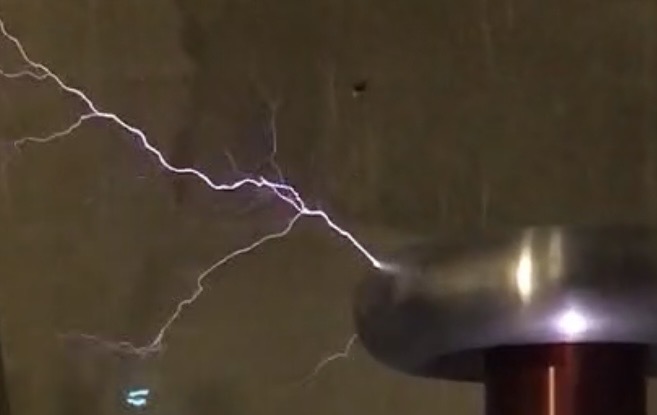
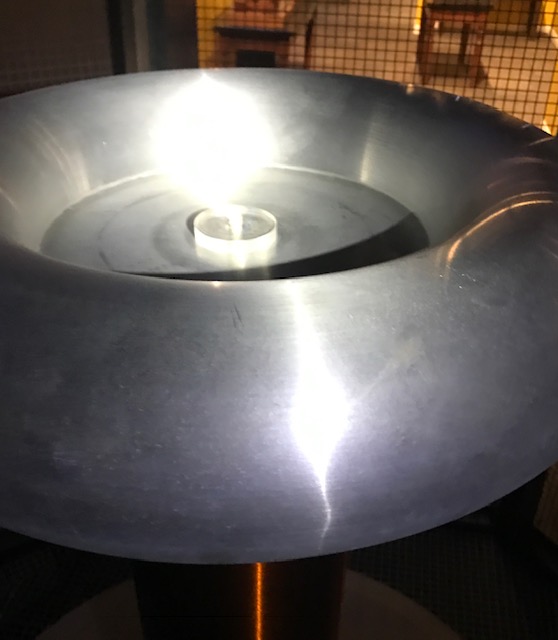 A lighting-like discharge from the toroid occurs when the electric field at its surface exceeds the breakdown voltage of the air, ripping electrons out of the air molecules, generating a conductive plasma, and producing a lightning bolt.